

When to Use a Knowledge Graph (And When It’s Overkill)

Knowledge graphs are having a moment. Everyone seems to be adding them to their stack, and every technical blog is hyping their potential. But here’s the truth: most projects that implement knowledge graphs would be better off with a simple database and some well-written queries.
I learned this the hard way during my research at Vidyaastra. After building several sample knowledge graph-based systems, I’ve developed some (rather strong) opinions about when they’re brilliant and when they’re just expensive complexity.
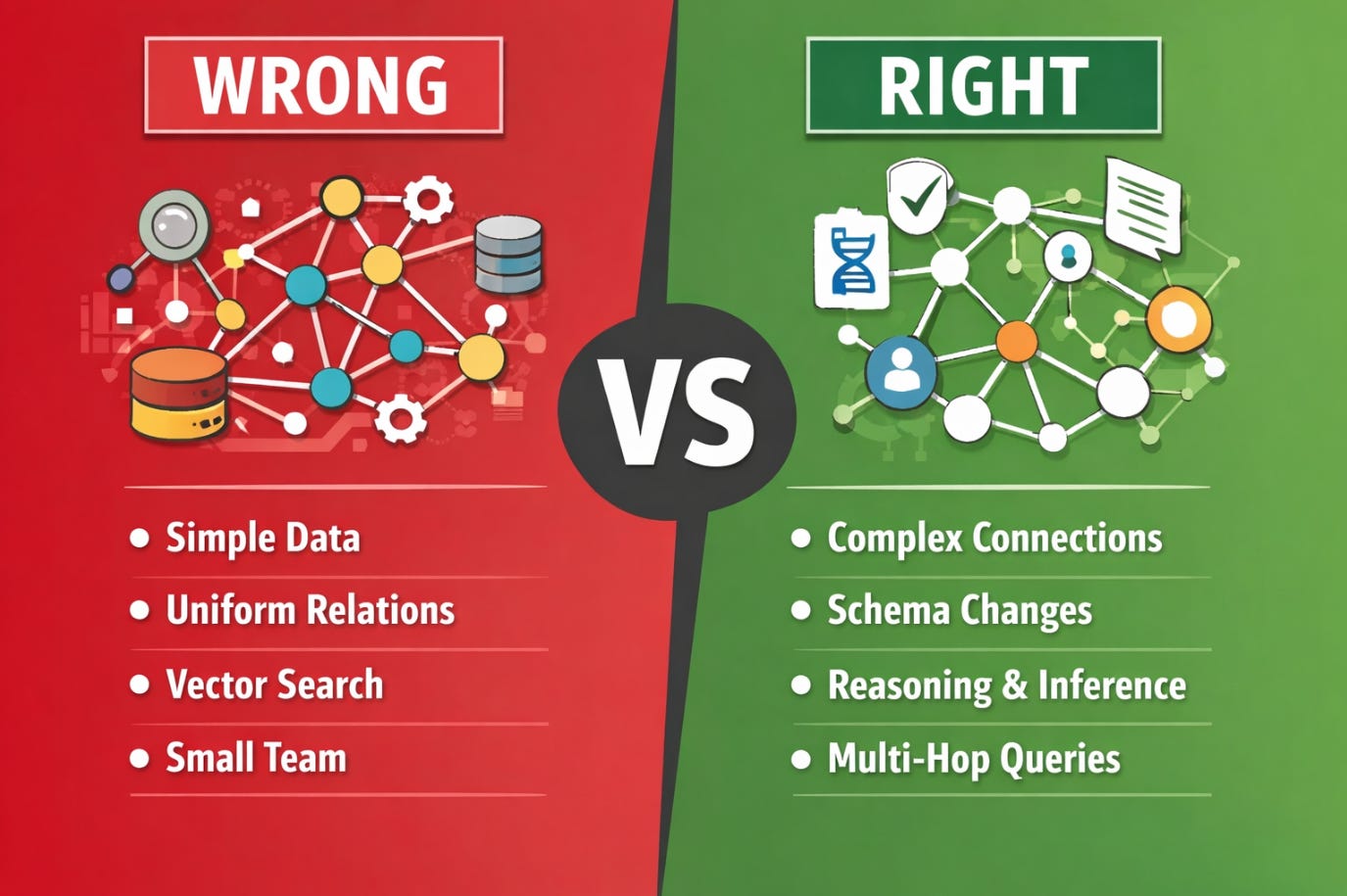
Table of Contents:
The Knowledge Graph Hype Cycle
When Knowledge Graphs Are Overkill
You Have Simple, Hierarchical Data
Your Relationships Are Uniform
You’re Just Doing Vector Search
You Don’t Actually Need Reasoning
Your Data Doesn’t Change Much
When Knowledge Graphs Actually Make Sense
Highly Connected, Heterogeneous Data
Frequent Schema Evolution
Reasoning and Inference Are Core Requirements
Multi-Hop Relationship Queries
Integrating Heterogeneous Data Sources
Explainability Matters
The Decision Framework
Complexity Check
Value Check
Capability Check
The Hybrid Approach (What Usually Works Best)
Real-World Example: Right Tool, Wrong Scale
Bottom Line
1. The Knowledge Graph Hype Cycle
What people think knowledge graphs do:
Magically connect all your data
Make your AI system “understand” relationships
Automatically infer new knowledge
Scale to Google-level complexity effortlessly
What they actually do:
Provide a flexible schema for connected data
Enable graph traversal queries
Support ontology-based reasoning (if you build it)
Create maintenance overhead you didn’t expect
2. When Knowledge Graphs Are Overkill
1. You Have Simple, Hierarchical Data
Don’t use KG if: Your data fits nicely into tables with clear parent-child relationships.
Example: E-commerce product catalog
Products → Categories → SubcategoriesUse instead: PostgreSQL with foreign keys
Why: A well-designed relational schema will be:
Faster to query
Easier to maintain
Better supported by existing tools
Cheaper to operate
Your queries look like: “Get all products in category X” — this is a simple JOIN, not a graph problem.
2. Your Relationships Are Uniform
Don’t use KG if: All your relationships are the same type and depth.
Example: Social network with only “friend” relationships
User → follows → User (that’s it)Use instead:
PostgreSQL with a simple join table for a small scale
Redis for in-memory lookups if speed is critical
Neo4j, if you need graph algorithms (shortest path, community detection), but without the ontology/reasoning overhead
Why: Knowledge graphs (with ontologies, RDF, SPARQL, inference engines) shine when you have heterogeneous relationships with semantic meaning. If everything is “user follows user,” you don’t need OWL ontologies or SPARQL. A simple graph database or even SQL is sufficient.
3. You’re Just Doing Vector Search
Don’t use KG if: Your main use case is semantic similarity search.
Example: “Find documents similar to this query”
Use instead:
Pinecone, Qdrant, Weaviate
PostgreSQL with pgvector
OpenSearch with k-NN
Why: Vector databases are optimized for this. Adding a knowledge graph on top doesn’t make your embeddings more accurate. You would waste months building graph layers that add zero value to the RAG pipeline.
4. You Don’t Actually Need Reasoning
Don’t use KG if: You never ask questions like “What can I infer?” or “What’s the transitive relationship?”
Example: Simple CRM — store contacts, companies, deals
Contact → works_at → Company
Company → has → Deal
Use instead: Any modern RDBMS with proper indexes
Why: Without inference or complex graph traversal, you’re just using a knowledge graph as an expensive document store. The classic mistake: “We might need inference later” (spoiler: you won’t). :-)
5. Your Data Doesn’t Change Much
Don’t use KG if: You’re loading static reference data once.
Example: Periodic table of elements, country codes, zip codes
Use instead: JSON files, SQLite, static lookup tables
Why: Knowledge graphs excel at evolving schemas and relationships. If your data is stable, the flexibility is unnecessary overhead.
3. When Knowledge Graphs Actually Make Sense
1. Highly Connected, Heterogeneous Data
Use KG when: Your relationships are the data.
Example: Drug discovery
Drug → treats → Disease
Drug → causes → SideEffect
Drug → interacts_with → Drug
Gene → associated_with → Disease
Protein → encoded_by → Gene
Why it works: You need to traverse multiple relationship types in a single query. “Find drugs that treat diseases associated with this gene but don’t interact with the patient’s current medications” is naturally a graph query.
Real benefit: SQL with 6-way JOINs is a nightmare. Graph traversal is elegant.
2. Frequent Schema Evolution

 | A guest post by
|